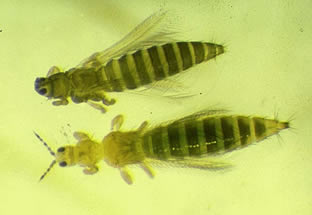
Thrips vary in color from white to yellow to brown. The adults are very small, 1/6 inch long, slender and pointed at both ends. The males are wingless, extremely rare and are not needed for reproduction.
The adult females have four slender wings which, when folded, extend slightly past the tip of their abdomen. Wings are fringed with long hairs.
In the field, adult thrips may be identified by their small size and rapid movement on the leaf surface. There are numerous subfamilies. Many species are beneficial, either preying on other insects or pollinating plants.
Two species are of economic importance in the PNW.
The Onion thrips, Thrips tabaci (Linderman) is a major crop pest in the Columbia Basin.
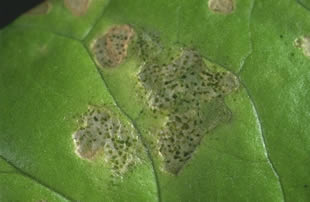
The Western Flower thrips, Frankliniella occidentalis (Pergrande) is a pest in some crops and is a useful pollinator in others. WFT often stipples the leaves of potato and tomato plants in the home garden. The image at left shows typical WFT damage.
The problem is one of identification. In the home garden and non onion crops, the WFT is the usual thrips. But, It is very hard to determine which thrips is which when making economic threshold calls. See below for a side by side view of both species.